Leaf to Thread: The Work Behind a Single Strand
Before it's cloth, before it's even thread, a length of HYPATIA Serat starts out with an unglamorous name: PALF — pineapple leaf fibre, the raw material behind every stage that follows. Four stages carry it from leaf to thread, and each one does something the last one couldn't.
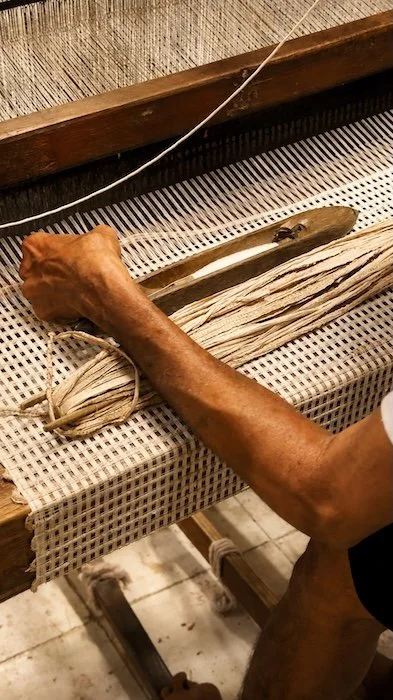
Extraction: Where the Leaf Gives Up Its Fibre
It starts with a leaf, close to a meter long, thick and waxy, held flat against a scraping tool. A hand draws the tool down its length, again and again, working the green pulp away and leaving pale, wet strands underneath — not yet a fibre so much as a loose comb pulled straight from the leaf's own spine. That's extraction: separating fibre from flesh, one pass at a time, gathered after West Sumatra's pineapple harvest, redirected from a stream that continues regardless of what HYPATIA does with it.
Cleaning & Drying: Removing Everything That Isn't Fibre
Those pale strands still carry the leaf's own moisture with them, flecked with pulp that scraping alone never fully lifts. Cleaning washes that residue out, strand by strand, until fibre is all that's left. Then it goes into the open air to dry, under West Sumatra's own sun, turning from wet and pale to dry and straw-coloured — brittle enough to snap cleanly if bent, exactly the state it needs to be in for what comes next.
Sorting & Preparing Fibres: Not Every Strand Is Equal
Not every strand that survives drying is equal, and treating them as if they were would show up in the finished cloth. Hands move over the pile, working by feel and by eye — the longer, cleaner strands into one pile, the shorter, coarser ones into another. No machine runs through this treating every strand the same; it's a judgement made fresh for every handful, before any of it is ready to be spun.
Spinning & Blending: Where Cotton Earns Its Place
Pineapple fibre up close gives away its own problem: strands only a few centimeters long, however long that leaf once was. Length is the real obstacle — spinning needs fibres long enough to overlap and grip each other continuously along a thread, and pineapple fibre alone runs out of length before a spinner can do much with it. Cotton's own longer, naturally crimped staple supplies the length and grip pineapple runs short of, and the two are drawn out and twisted together, cotton carrying pineapple's shorter strands the distance of the thread.
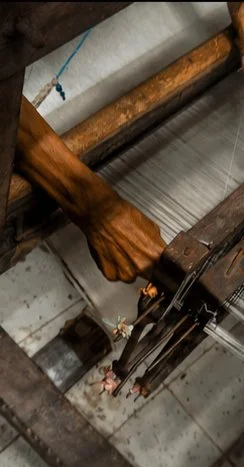
One Thread, Not Yet the Whole Story
What comes off the spinning stage is one thread — the pineapple-cotton thread, on its own spool. It isn't HYPATIA Serat yet. A second thread, 100% Uzbek silk, is prepared entirely separately, and only when the two meet does the material actually exist.
Why This Is Worth Knowing
Extraction, cleaning, sorting, spinning — four different kinds of work, four different sets of hands, and none of it visible in a finished garment. What happens next is its own story: two threads, pineapple-cotton and silk, finally meeting at a loom, where HYPATIA Serat actually becomes cloth. That's where a leaf's long journey turns into something you can wear — and it's a story for another day.