Restu's Process: From Raw Fibre to Weave Structure
Ask Restu Imansari Kusumaningrum what she loves most about her work, and she doesn't start with the finished cloth. She starts with the villages — staying with the women who make the batik and the colour, watching a design take shape before it becomes anything close to a garment.
Where It Begins: The Pineapple Women
The material starts in West Sumatra, with a harvest whose primary purpose has nothing to do with textiles. Pineapple is grown for fruit. Once it's picked, the leaf is left behind — treated, ordinarily, as agricultural residue with nowhere left to go.
Every three months, that leaf is gathered by the women who farm it, cut and cleaned on-site, and paid for immediately, by the kilo, as soon as the collection is done. Restu works directly with these women, coordinating the harvest cycle in person rather than through layers of procurement. The leaf is then carried by truck to Central Java, where its second life as a textile fibre actually begins.
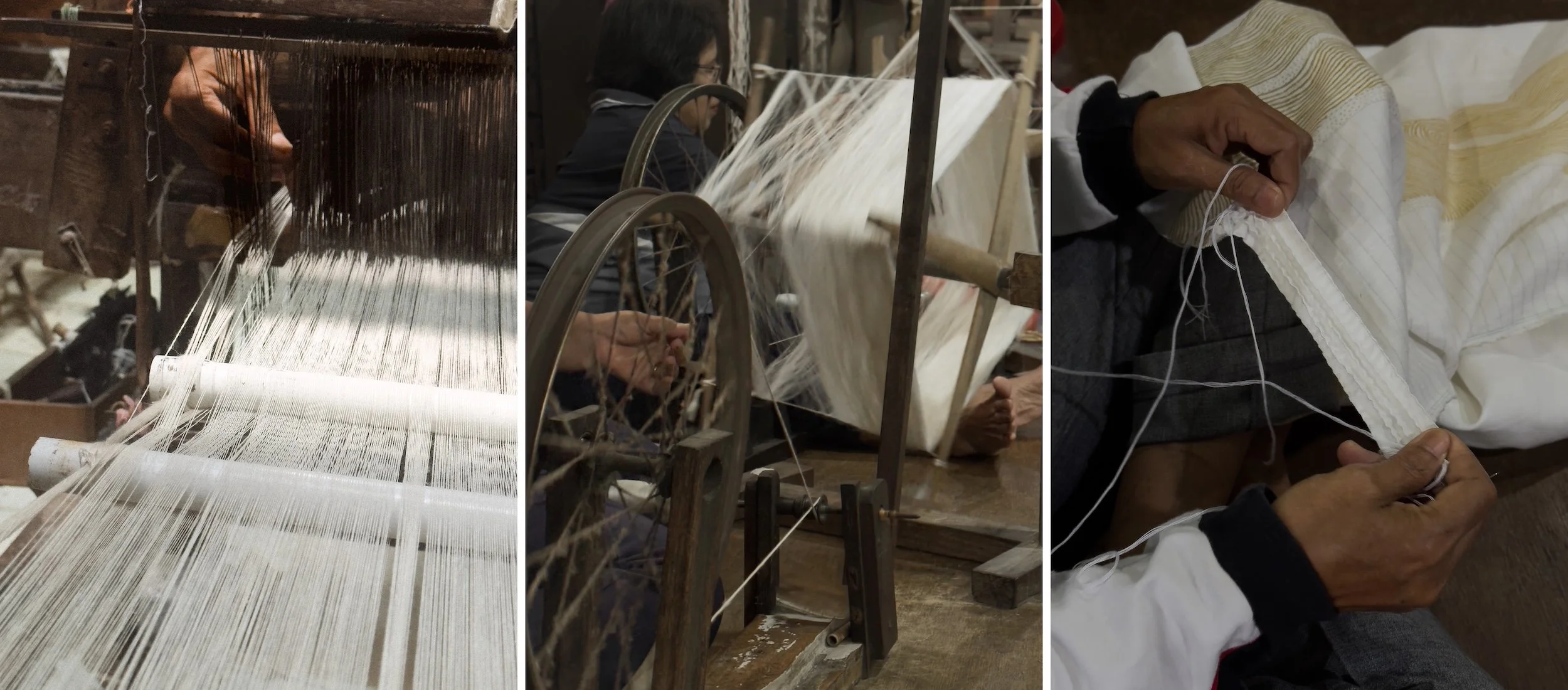
From Leaf to Thread
In Central Java, the fibre is worked slowly into thread and blended with cotton to form HYPATIA's base cloth. The silk that blends into HYPATIA's textile travels a longer route — sourced from Samarkand, Uzbekistan, along what was once the Silk Road.
The Slowness Is the Point
From a single length of cloth, HYPATIA's weavers may produce forty metres over two weeks. Natural dyeing alone takes about three weeks. Colour is drawn from the earth — tree bark, indigo leaves, the skins of fruits and vegetables — a process that resists acceleration in the same way Sulam embroidery does.
Restu's Role in All of It
Restu's work as principal material designer sits at the centre of this entire chain — not overseeing it from a distance, but staying close to each stage, from the harvest through to the finished weave. The women are paid on a routine, every two weeks, throughout. The structure exists to protect them as much as it exists to produce cloth.
What This Process Actually Yields
By the time HYPATIA Serat reaches a finished garment, it has passed through the hands of pineapple farmers, spinners, batik artisans, natural dyers, weavers, and embroiderers — each stage its own discipline. Restu's process is a chain of specific, named skills, coordinated by someone who insists on staying close enough to know all of them personally.
