The European Union's Digital Product Passport is still a few years from mandatory for clothing - a textiles-specific rule is expected in early 2027, with compliance likely required from 2028 or 2029 depending on a company's size.
Once it arrives, every garment will need to carry its own digitised record: fibre composition, traceability, care instructions, repair and recycling information, all attached to the product itself through a QR code or similar, rather than living in a press release or a brand's own claims. As one manufacturer's creative director put it recently, the rule "is pushing us to document everything about a garment."
HYPATIA had already landed on a word for its own version of that, months before the EU's passport entered the conversation - not because of the regulation, and not in response to it, but because an authenticity document needed a name, and "passport" was the only word that fit.
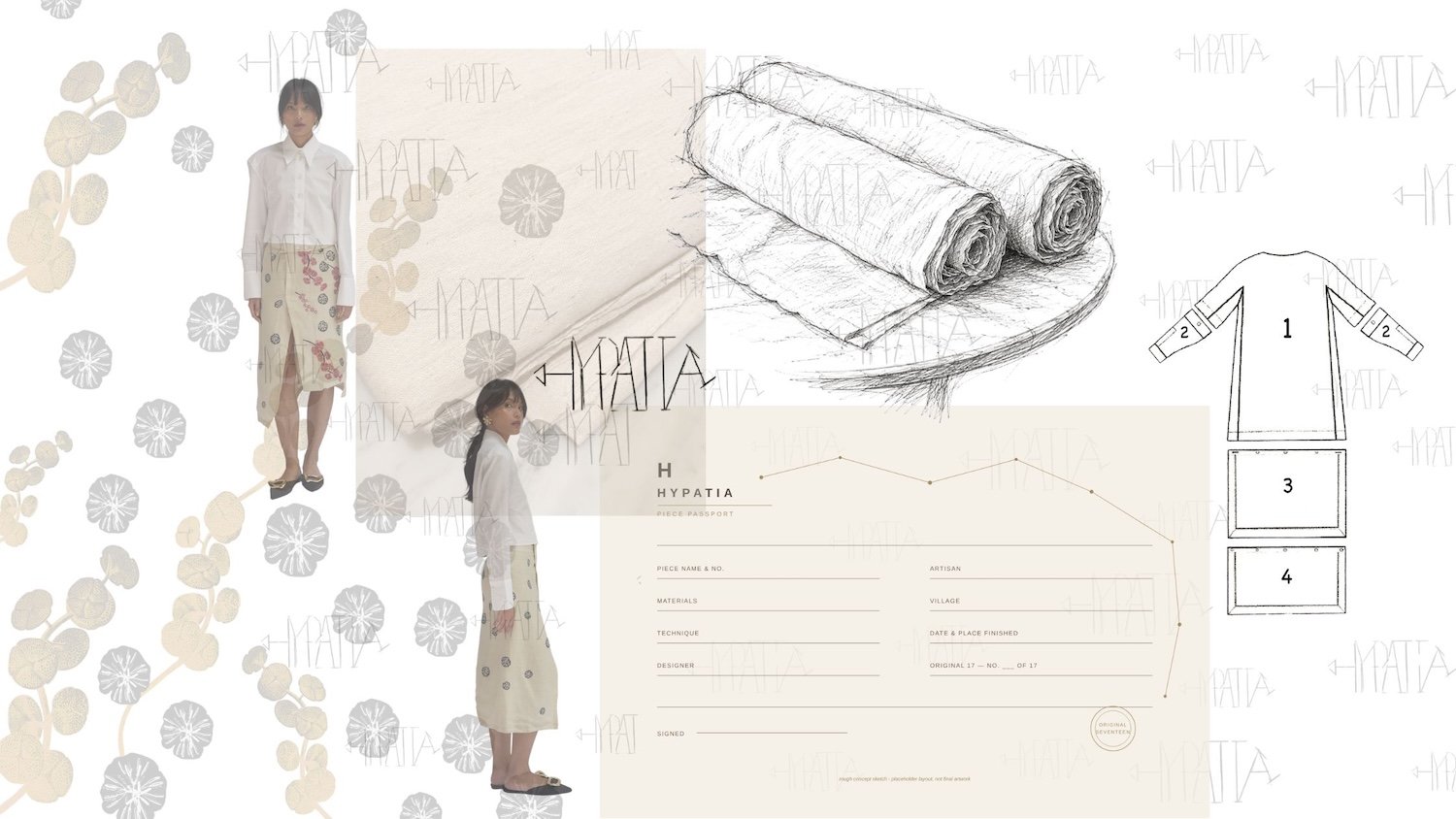
Each of the Original 17 will carry its own Piece Passport: the piece's name and number, the techniques and materials used to make it, confirmation that it's cut from the R&D-phase material HYPATIA was still learning to work with - material that no longer exists to be made again - Bettina's own signature and attribution as its designer, the artisan and village credited for making it, and the date and place it was finished.
The two passports exist for almost opposite reasons. A Digital Product Passport exists because distance makes it necessary - someone far from the making needs a way to trust what they're buying, so the proof has to travel with the object itself. A Piece Passport exists because closeness makes it possible - every fact on it is something HYPATIA already knows firsthand, named by the people who did the work, not something gathered after the fact to satisfy a form. Two passports, arriving from opposite directions, ending up at some of the same information anyway.
The first Piece Passports go out with the Original 17, at the auction in 2027 - HYPATIA's own version of a passport, already carried by seventeen pieces, years before the industry's is required to exist at all.
READ FURTHER
"Denim manufacturers prepare for DPP law" - Ecotextile News, 8 July 2026. https://www.ecotextile.com/2026070863956/news/environment/denim-manufacturers-prepare-for-dpp-law/