The Stitch That Takes Longest
A HYPATIA embroidery motif - what HYPATIA calls a Ragam Hias - arrives in the villages already whole. Every line, every curve, every space Bettina has left deliberately open has already been decided, on paper, before a single stitch is ever considered. What happens after that handoff belongs entirely to the hands that receive it.
Bettina's design is traced first onto paper, then again from that paper onto the fabric itself: by hand, exactly as she drew it, becoming the precise map every stitch that follows will keep to. Nothing of the design changes across either step. It only moves - first onto paper, then ontocloth - waiting now for a needle rather than a pencil, and from there, the rest of the traditional process takes over.
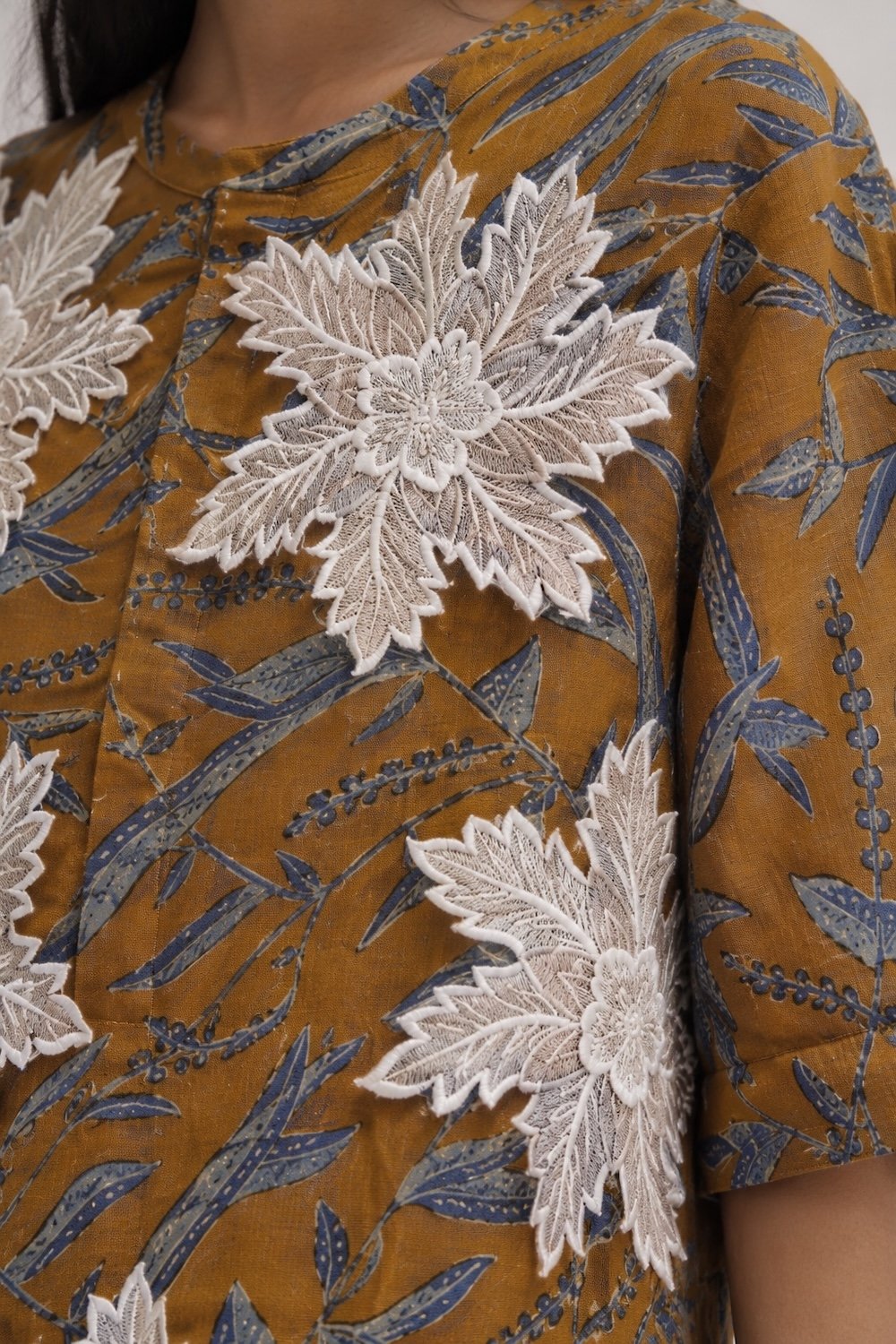
From that traced outline, a single Ragam Hias can take a full day to complete, sometimes longer, and that holds true whichever of the two ways it's made. HYPATIA makes two kinds: a dimensional piece, embroidered as a 3D appliqué and then hand-stitched onto the material, set into the cloth like a form raised from its surface; and a flat design worked directly onto material that already carries its colour - dyed, and often patterned first in Bettina's hand-drawn Batik Tulis - with the embroidery added last, on top. The first is Sulam Tangan. The second is Sulam Mesin. Two named techniques carrying two different rhythms, but the same amount of a trained hand behind every stitch.
Sulam Tangan is embroidery in its most direct form: needle and thread, held and moved entirely by hand, one stitch decided at a time. A floral cluster starts as a shape, appliquéd into place, then built outward in short, deliberate stitches until it holds its own dimension - a piece made whole on its own, then hand-stitched onto the material it will finish. No two clusters come out quite the same, because no two hands move through them the same way twice.
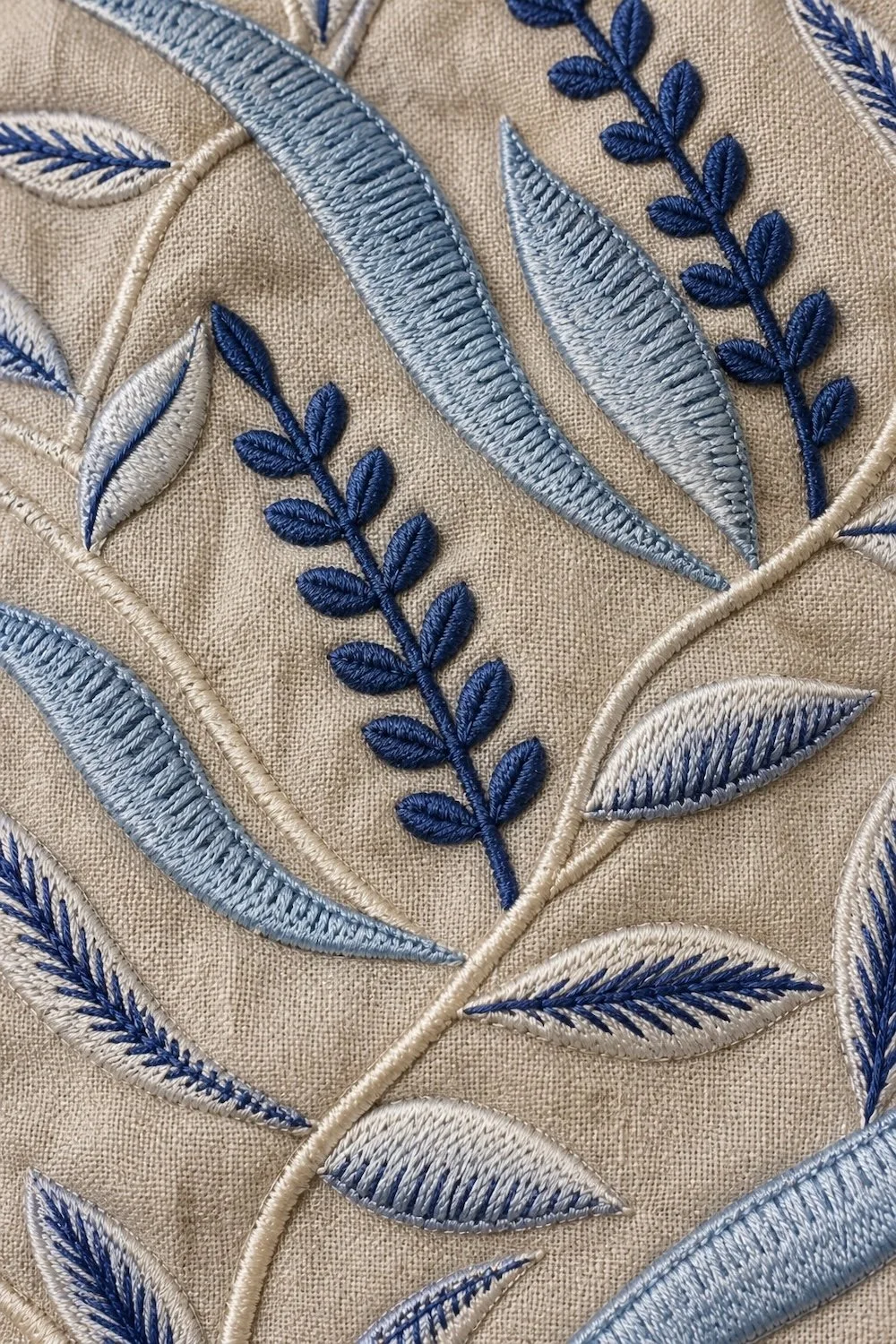
Sulam Mesin brings a machine into the process, though not the kind that comes to mind first. It belongs to a tradition of hand-guided embroidery machines going back more than a century and a half - built so a mechanised needle does the stitching, while a trained hand does everything else: the direction, the speed, the shape of every curve, steering the cloth beneath the needle exactly as a hand-embroiderer would steer a needle through it, just with the needle now set into a machine instead of held between the fingers. HYPATIA's Sulam Mesin is worked onto material that has already been given its colour - dyed, and often patterned first in Batik Tulis - with the embroidery added last, on top. A computerised embroidery machine, the kind most familiar outside Indonesia, loads a digital file and stitches a hooped section of fabric on its own, running a pattern set once and repeated exactly, as fast as an industrial line wants it to go. Sulam Mesin runs on something else entirely, and HYPATIA never asks it to move at that pace: a person's eye and hand, trained over years, steering cloth through a pattern the machine itself has no memory of, at exactly the speed that hand can hold.
Both techniques carry the same weight of knowledge, passed from one pair of hands to the next: what a stitch needs to hold a shape, how tightly a curve can turn before it pulls, when a Ragam Hias is finished and when it still needs another pass. None of that shows in the finished piece the way the pattern itself does. A bodice covered edge to edge in Sulam - by needle or by machine-guided hand - carries a day, or a week, that someone gave to making it exist.
At HYPATIA, Sulam Mesin is led by Mrs Ecah, eighty years old, and lately her son has been at the machine beside her, learning the same motion she once learned from someone before her. Mrs Ecah retires from the workshop at the end of this year, which makes the hand now beside hers the whole of how this knowledge carries forward - not written down, not stored anywhere but in a pair of hands passing it to another pair, in the same room, over the same cloth. It's also the part of craft that's easiest to lose. A skill like Sulam only survives as long as someone newer to it wants to take it on, and that want isn't automatic - a hand-guided stitch has to earn attention against everything that looks faster or more modern to someone just starting out. Keeping Sulam Tangan and Sulam Mesin going at HYPATIA means more than finishing a well-made Ragam Hias. It means making sure the people who could learn this next actually choose to - carried forward by hands that see real value in holding it, generation after generation, not simply by whoever happened to be born after those who already knew it.
HYPATIA keeps both techniques exactly as slow as the hand behind them needs, for exactly this reason. The pace was never about which one moves faster. It's about a body of skill staying in hands that want to hold it - the ones carrying it now, and, just as much, whichever hands choose to carry it next.