Tea With Bettina and Restu
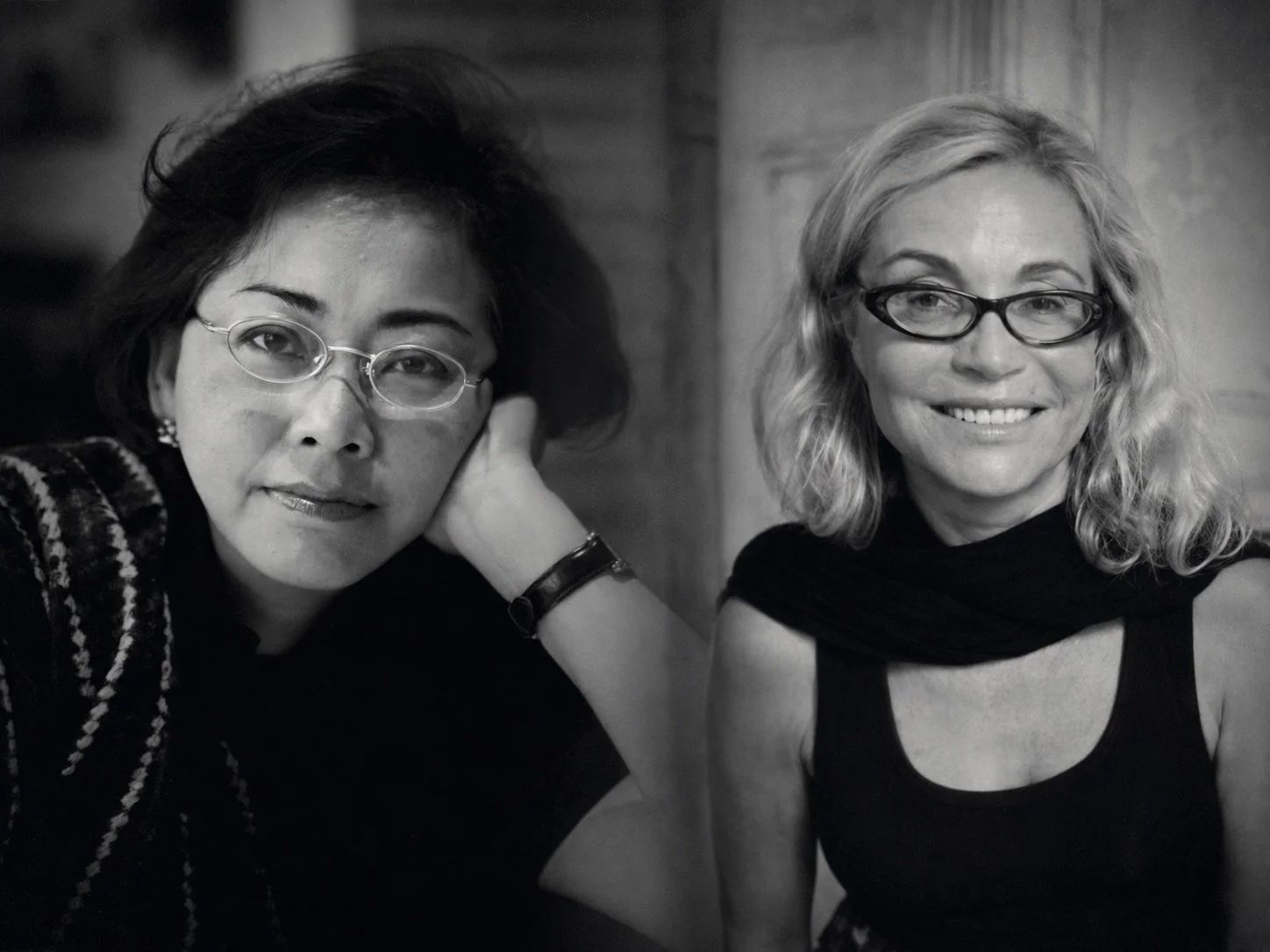
Two names sit behind everything HYPATIA is, even when only one appears on the label. And if you sat down with the two of them - shoes off, the tea slowly going cold because nobody remembers to drink it - you'd learn that a lot faster than any bio ever tells you.
Restu
Ask Restu Imansari Kusumaningrum what she does and she'll undersell it completely: something about “working with villages,” said the way someone describes a hobby rather than a life's work. What she'll leave out, unless you press her: years as a dancer and choreographer before any of this, a production of I La Galigo with Robert Wilson that carried the world's longest epic into UNESCO's own record of cultural memory, the Indonesian Heritage Preservation Agency she founded from scratch, and two national honours - one from Italy, one from Indonesia - that she'd rather talk around than about. Press her on why any of it matters to her, though, and she lights up properly for the first time: it was never really about the recognition, she'll say. It's a real conversation between old and new: how something ancient can sit comfortably in a room built today, and how today still has plenty left to learn from what came before it.
That conversation is exactly what she has for a living now, just with villages instead of theatres. She's the one who travels, between regions, between communities, sitting with the artisans whose hands make HYPATIA real, watching over every embroidered piece and every length of material as it comes together. HYPATIA Serat exists, in the most literal sense, because Restu decided it should.
Bettina
Everything about Bettina WitteVeen is exact, right down to the life she's built. Decades as a conceptual artist, building exhibitions and installations around things she cared about long before it was fashionable to say so out loud - peace, animal welfare, communities getting a fair deal - run alongside just as many years spent inside the communities those causes were about, in Southeast Asia and beyond. Neither one explains her more than the other; both come from the same place.
Her presence is entirely impossible to miss in a room: a total kind of confidence that never needs to raise its voice to be felt. Get her talking about the things she loves - nature, people, the different eras and worlds she's moved through - and she opens up completely; you could sit and listen for hours. Give her a real reason to raise that voice, though - a stage, a cause, a moment that calls for someone to take a stand - and she's the first one on her feet.
That same instinct is where most of her activism comes from. At HYPATIA, that instinct doesn't stop at ideas. She's the one drawing the patterns, choosing the buttons, deciding what a garment looks and feels like, down to the smallest detail.
She designed the button-only closure that holds every Combinables piece together, built entirely from what the village already had on hand: no plastic, nothing that has to be cut away and thrown out once a garment finally comes apart. Most closures on a piece of clothing are exactly the kind of thing that ends up as waste; hers are made so every single one can go back into the earth instead. Her patterns work the same way. Every one she designs is its own small act of activism: a way of putting a creature that has no voice of its own, and that nobody else is talking about, somewhere impossible to ignore: a fish, an insect, a small animal most people would walk straight past. She researches it properly before she draws a single line, and gives it a place on cloth people want to wear. Colour gets the same care, developed and redeveloped, sometimes dozens of times over, until it carries the story she's trying to tell rather than just approximating it.
The real thread between Bettina and Restu was never really about geography or perhaps even a shared address book.
It's what they were each already fighting for, long before either one had heard of HYPATIA.
Restu's years as a dancer and choreographer went toward exactly the same question Bettina's art asks: how do you make people pay attention to communities, cultures, and creatures that spend most of their lives being spoken over or ignored completely. Both of them, as it happens, also have their own separate history with Robert Wilson's Watermill Center in New York: Restu rehearsing I La Galigo there in 2002, Bettina's first project “Sacred Sister”, tracing back to a residency there.
Bettina sees what a piece should become. Restu knows exactly what the material, and the people who make it, can carry.
Somewhere between the two of them, checking each other the whole way, is where HYPATIA gets made. You could read two résumés and come away impressed. Sit with Bettina and Restu instead, and you understand something a résumé can't tell you: two women who had already decided, long before HYPATIA existed, to spend their lives speaking up for whoever and whatever needed it most, and who happened to find, in each other, someone doing exactly the same work in a different language.